
Your first milestone
The universe's story
Explore key milestones from the early universe through Earth, life, and human history.
Read more & sources
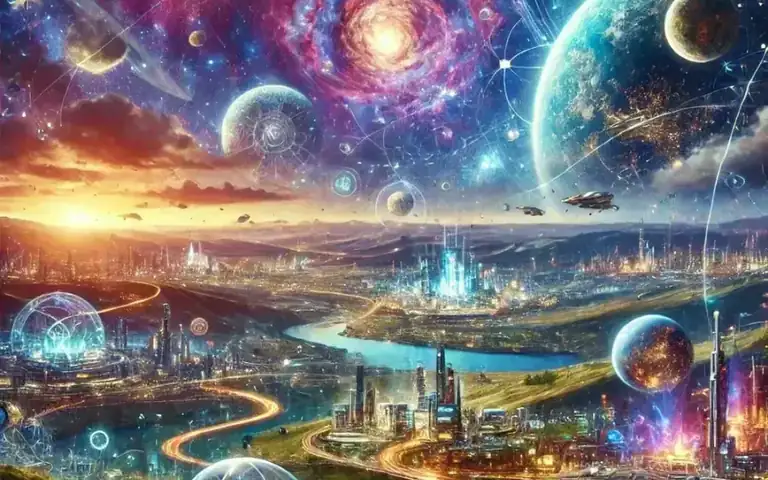
Conceptual artwork; appearances and scale are illustrative.
13.8 billion years. One story.
Discover the universe, Earth, and us — one milestone at a time.
Preparing the time machine…
Start here
Use Next milestone to follow the story, from the Big Bang to today.
Your first milestone
Explore key milestones from the early universe through Earth, life, and human history.
Conceptual artwork; appearances and scale are illustrative.
Equal distances = equal time. Recent events crowd near today; choose a smaller scale to spread them out.
Cosmic calendar: January 1
Illustrative scenes change with time; the dates and timeline carry the scale.
The guessing game
Drag the gold circle to where you think the event belongs. Then choose Check my guess to see the answer.
Round 1 of 5
Whole universe
Gold circle = your guess · Blue diamond = answer (after checking)
Make a guess, then reveal its place in time.
0 of 0 scale estimates close
Estimate the scale, rather than an exact date. Within 2.5% of the displayed window counts as close; milestone dates are rounded.
Choose Next milestone to follow the story in order, or Choose a milestone to jump to a topic. The artwork, date, and short explanation describe that milestone. Open Read more & sources for the full story. Play the guessing game is a separate five-question activity; you can switch back to exploring at any time.
Drag either slider with a mouse, finger, or pen. With a slider focused, use arrow keys for small changes, Page Up or Page Down for larger steps, and Home or End for the edges. Previous and Next milestone move between events. The topic search provides another route to every milestone without changing the current scale when it fits. When you drag between milestones, the card shows the nearest milestone; its date may differ from your selected time. Choose a smaller Timeline scale to spread out recent events.
More time tools & moving illustration contains an illustration of your selected time, the cosmic calendar, zoom controls, and exact time entry. Zoom in here takes a closer look at the selected moment; Whole universe restores the full scale. Jump to a specific time accepts years ago, including 0 for the present.
Play time moves linearly through the selected window. Pause to explore a moment. Changing the window, selecting an event, or switching to the guessing game pauses playback. Leaving the tab pauses it; resume when ready. Illustrations have no automatic idle animation.
The five-round game uses different time windows. Move the circle on the timeline, check your guess to reveal the answer diamond, then continue. The result compares your guess with the milestone and shows whether you placed it earlier or later. The score rewards estimates within 2.5% of the displayed span; that is a scale exercise rather than a test of exact archaeological dates. Replay for another ordering.
Imagine the universe's history compressed into one ordinary 365-day year. The beginning maps to January 1 and the present to the end of December 31. Every event uses the same conversion, even when you zoom into a shorter window. This is an analogy for elapsed time, not a real calendar date.
Recent history takes up a tiny fraction of that year. Use the closer time windows to inspect events that appear together at the right-hand edge of the whole-universe view.
Milestones are selected reference points in processes that often lasted millions of years. Dates are rounded, and early evidence can be debated. Each event includes supporting sources and a note explaining its limits. Rounded ages for calendar-year events use 2026 as the reference year.
The scenes are illustrations, not physical simulations or literal reconstructions. Timeline spacing represents time, not distance through space. The beginning is described as an early hot, dense expanding state; the page does not treat a physical singularity as an observed event.
These are selected reference points, not a complete history or a ranking of importance. Extra detail near the present helps us explore our own story, but the timeline always keeps its true linear spacing. A recent invention and the formation of a planet can each have a card without representing equal amounts of time. Use Whole universe to see that difference, or a smaller scale to explore recent events.
The future is an open question. Discoveries and choices will shape what comes next. Future scenarios are speculation and have no assigned place among the dated historical milestones.
 Gravity Lab
 Elemental